
NEUROLOGICAL & BALANCE REHABILITATION · STAFFORD & FREDERICKSBURG, VA
Multiple Sclerosis, Fatigue, And Energy Budgeting
MS rehabilitation requires an individualized approach because more effort is not automatically better, and the clinician must recognize that physical capacity can fluctuate. This page explains how in-home physical therapy helps with walking, balance, fatigue and heat sensitivity, and why the pacing is the treatment.

THE SHORT ANSWER
Can Physical Therapy Help With Multiple Sclerosis?
Physical therapy and appropriately dosed exercise can improve important areas affected by multiple sclerosis, including balance, walking endurance, mobility, fatigue management, and quality of life. A 2024 meta-analysis of 40 randomized controlled trials found significant improvements across each of these outcomes with exercise interventions.
The goal is not to “push through” MS. It is to identify the right challenge for your current capacity, build strength and movement efficiency, address balance and walking limitations, and develop strategies for fatigue and heat sensitivity.
Divine Physical Therapy provides mobile, one-on-one neurological rehabilitation primarily throughout Stafford County, Virginia, with select surrounding-community visits based on location and scheduling.
Rehab That Respects A Moving Ceiling
Exercise is beneficial for many people living with multiple sclerosis, but the dose needs to fit the person and the day. MS-related fatigue, heat sensitivity, weakness, balance changes and fluctuating symptoms can all affect how exercise is planned. The goal is enough challenge to create adaptation without ignoring symptoms that should change the plan.
Reviewed by Dr. Thea Paige, PT, DPT, CMTPT, PCES

DOSING
Why Is MS Rehabilitation Different From Other Rehab?
Progressive exercise still matters in MS, but progression should be individualized and adjusted for symptoms, recovery, heat sensitivity and fatigue. MS fatigue can have multiple contributors and may fluctuate from day to day, so the same exercise dose will not always be appropriate at every visit.
Exercise dosage should balance progressive challenge with symptom response. That may mean adjusting resistance, duration, rest intervals, environment or the type of activity from one day to the next. The objective is sustainable progression — not exhaustion.
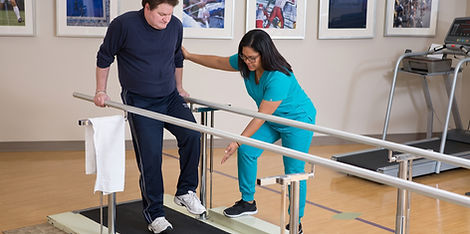
This does not mean avoiding challenge. Resistance, aerobic, balance and multicomponent exercise can all have a role. Recent evidence supports exercise for improving balance, walking endurance, fatigue and quality of life in people with MS; the appropriate combination depends on the individual’s presentation and goals.
PACING
What Is Energy Budgeting?
Treating your daily energy as a finite budget to be spent deliberately. The goal is consistent accumulation of activity, not maximum effort on any single day.
Shorter, More Often
Shorter, more frequent exercise bouts instead of long sessions.
Best Hours First
The hardest tasks scheduled at your best hours.
Rest Early
Rest built in before it is needed rather than after.
Honest Choices
Honest choices about which activities are worth their price.
This is also where a 75-minute in-home session earns its length — there is room to train, to rest, and to redesign the day itself: where the laundry lives, how the kitchen sequence runs, which trips upstairs can be consolidated. Energy conservation strategies and physical training are part of the same conversation here, with occupational therapy collaboration when appropriate.
HEAT SENSITIVITY
Why Heat Worsens MS Symptoms And What Helps
For some people with MS, even a small rise in core temperature can temporarily worsen neurologic symptoms, often called Uhthoff’s phenomenon. These temperature-related changes generally improve as body temperature returns toward baseline and do not necessarily represent a new relapse.
Strategies may include a cooler exercise environment, planned rest, hydration, pre-cooling or other cooling strategies when appropriate.
At home, the thermostat is yours. Even during a Virginia July, the treatment environment can be adjusted to support safer, more comfortable exercise—which is one more reason in-home MS therapy can be a clinical advantage, not simply a convenience.
MOBILITY
What About Walking, Balance And Falls?
Walking and balance are important rehabilitation targets in MS. A 2024 meta-analysis including 2,127 participants found that exercise improved balance, walking ability and walking endurance; the pooled improvement in the 6-Minute Walk Test was about 25.6 meters compared with control conditions. Treatment may include lower-extremity strengthening, gait training, dynamic balance, endurance work and task-specific practice based on the findings of your evaluation. Because vision, sensation, weakness and fatigue can all influence balance, fall risk is considered as part of the plan. The broader approach is explained on the balance and fall prevention page.


Where a cane, trekking pole or other aid earns its place, it is fitted and trained rather than merely suggested — the right tool preserves the energy budget for the parts of life you care about spending it on.
RELAPSE
What Happens During A Relapse?
A suspected new relapse or meaningful new neurologic change should be communicated to the medical team managing your MS. Physical therapy may need to be modified, paused or redirected depending on the symptoms, medical recommendations and safety considerations. As symptoms stabilize, rehabilitation can be progressed according to your current function rather than automatically returning to the previous exercise dose.
A 2024 systematic review and meta-analysis of 40 randomized controlled trials found exercise-related improvements in balance, walking ability, walking endurance, fatigue and MS-specific quality of life. A separate 2024 review of 84 studies involving 3,786 participants also found benefits of several exercise approaches for fatigue and muscular fitness. The takeaway is not that one exercise program is best for everyone — it is that appropriately selected and dosed exercise is an important part of MS management.
EVIDENCE-INFORMED CARE
What Does The Research Say About Exercise And MS?
Exercise is no longer viewed as something people with MS should routinely avoid. Current research supports appropriately prescribed physical activity and exercise across the disease course, with the program adapted to the person’s abilities, symptoms, safety needs and goals.
2024 meta-analysis
Balance
Significant improvement on the Berg Balance Scale with exercise compared with control conditions.
Pooled results
Walking Endurance
~25.6 m
Improvement on the 6-Minute Walk Test.
Pooled analysis
Functional mobility
Timed Up and Go performance also improved.
Subgroup analyses
Fatigue
Exercise produced significant improvements in fatigue measures. Aerobic, resistance and multicomponent programs all showed benefit.
Same review
Quality Of Life
MS-specific quality-of-life scores improved with exercise.
Not promises
Group Averages
These are group averages, not promises of an individual result. MS varies widely between people and across the disease course, which is why evaluation and individualized dosing matter.
Du L, et al. (2024). Effects of exercise in people with multiple sclerosis: a systematic review and meta-analysis. Frontiers in Public Health.
Kalb R, et al. (2020). Exercise and lifestyle physical activity recommendations for people with multiple sclerosis throughout the disease course. Multiple Sclerosis Journal.
Wallin A, et al. (2024). Effects of Balance Exercise Interventions on Balance-Related Performance in People With Multiple Sclerosis. Neurorehabilitation and Neural Repair.
Zhang X-N, Liang Z-D, Li M-D. (2024). Comparison of different exercise modalities on fatigue and muscular fitness in patients with multiple sclerosis: a systematic review with network, and dose–response meta-analyses. Frontiers in Neurology.
HOW SESSIONS ARE PACED
The Session Bends To The Day By Design.
01
Check The Budget
Every session starts by finding today’s ceiling — sleep, heat, symptoms, and what the week has already cost.
02
Spend Deliberately
The most important work happens first, at genuine but sustainable intensity, with rest built in on purpose.
03
Bank The Pattern
You leave with a home plan sized to real days — including the version for bad ones, so bad days no longer mean zero days.
YOUR QUESTIONS, ANSWERED
Frequently Asked
KEEP READING
Where To Go Next
Balance & Fall Prevention
Falls are not a normal part of getting older — how balance is measured and trained.
Parkinson’s Physical Therapy
Gait, freezing of gait and movement amplitude — and why starting early matters.
Neurological & Balance Rehabilitation
Stroke, Parkinson’s, MS, falls and the road home from inpatient care.

BEGIN WITH A DISCOVERY CALL
Build A Plan Around Your Function Not A Generic MS Exercise Sheet.
A complimentary Discovery Consultation will tell you honestly whether fatigue-paced, in-home MS therapy fits your situation — and what a first plan of care would actually look like.