
MANUAL THERAPY & DRY NEEDLING · STAFFORD & FREDERICKSBURG, VA
Cupping And Instrument-Assisted Soft Tissue Work
One lifts tissue with suction; the other works it with a smooth-edged tool. Both have had their turn as fitness-world spectacle — Olympic circles, dramatic before-and-afters. Both deserve a quieter description. They are useful adjuncts, in specific places, for specific reasons, and the marks they leave mean far less than the internet suggests.

FOUNDATION & DELIVERY
What Are Cupping And IASTM?
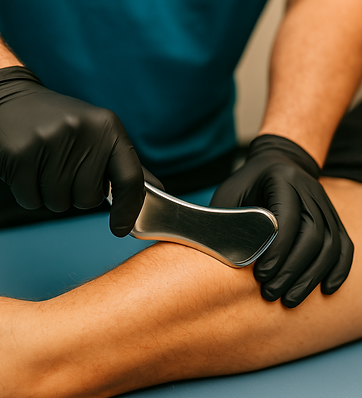
Cupping uses suction to lift and decompress soft tissue; IASTM - instrument-assisted soft tissue mobilization - uses a smooth-edged tool to apply precise pressure and shear to restricted tissue. Both are brief, targeted techniques used to reduce sensitivity and improve mobility before loading, folded into 75-minute sessions in your home across Stafford County and Fredericksburg, Virginia.
Neither is a standalone service or an extra charge here. They are options inside a plan of care, used when your examination suggests they will reach something better than hands alone. HSA and FSA cards may be used when your plan permits.
Cupping and IASTM both work, modestly, sometimes, for some people and both are oversold constantly. Here is the version you can trust.
Reviewed by Dr. Thea Paige, PT, DPT, CMTPT, PCES — about Dr. Paige.

DISMANTLING THE MYTHS
Why Does Cupping Leave Circular Marks?
The marks are bruising. Suction pulls skin and superficial tissue upward hard enough to break small capillaries, and the blood that escapes shows through the skin as those familiar circles, fading over several days like any bruise. That is the whole story — the marks are not toxins being drawn out, not stagnation leaving the body, and not a measure of how much treatment you needed.
Darker circles mean more capillary disruption, not more healing. A practitioner who reads your marks like tea leaves is decorating the technique with claims it doesn't need — because what cupping actually offers doesn't require mythology to be worth having.
MECHANICAL ACTION
What Does Cupping Actually Do?
Cupping is the one tool in the manual therapy kit that decompresses - every other technique, hands included, works by pressing in, while suction lifts tissue layers away from each other. Clinically it is used to reduce sensitivity and improve the mobility of restricted regions, most often across the upper back, shoulders and hips, before that freed motion is trained.
Honestly: nobody fully knows why cupping helps the people it helps. The evidence is modest and mixed, and the candidate explanations - changed local blood flow, novel sensory input quieting a guarded region, decompression of tissue layers - remain competing hypotheses, not settled fact. What is settled is what the marks are: simple suction bruising, nothing more.
FOUNDATION & DELIVERY
What Is IASTM - And Why Use A Tool Instead Of Hands?
Instrument-assisted soft tissue mobilization uses a smooth-edged tool, typically contoured steel to apply targeted pressure and shear along restricted tissue. The instrument does two things hands do less well. It concentrates force into small, specific regions, the tissue around the elbow, shin or heel and it transmits texture, letting the clinician feel restriction through the tool with surprising clarity. Treatment is brief minutes, not the whole session and immediately followed by loading so the change is reinforced.
It is not scraping the tissue into submission. More force is not better treatment, and skin redness is not a goal - the older 'breaking up scar tissue' framing has given way to the same honest mechanism story as most manual therapy: changed sensitivity and tolerance, consolidated by movement. Tendon and calf complaints in runners are a typical use - see how that fits a whole plan on our running injuries page.
SAFETY & CONTRAINDICATIONS
When Are These Tools Set Aside?
Leading with limits, as usual: cupping and IASTM are avoided or modified over broken, fragile or infected skin, active rashes or sunburn, with bleeding disorders or anticoagulant medication, over varicose veins, with lymphedema in the region, and during some stages of pregnancy depending on site. People who bruise very easily may choose lighter techniques instead - and preference alone is always reason enough to skip a tool.


"My rule for reaching past my hands is simple: the tool has to solve a problem my hands can't. A cup earns its place when a region needs lift instead of pressure; steel earns its place when the restriction is small, deep, or somewhere fingers fatigue before finishing. If I can't say what the tool adds in one sentence, it stays in the bag - and I'd rather tell you that than perform equipment at you."
INTEGRATED PROTOCOL
How Cupping And IASTM Fit A Session
Either tool typically occupies a few minutes inside the hands-on portion of a session, alongside myofascial release and - where examination calls for it - dry needling, before the freed motion is loaded and sent home as exercise. They are two instruments in the wider toolkit of manual therapy and dry needling care: never the plan, sometimes exactly the right page of it.
WHAT TO EXPECT, PLAINLY
If A Cup Or Tool Comes Out In Your Session.
A Reason First
You'll hear, in one clear sentence, exactly what the tool adds that hands don't — before it ever touches you.
Minutes ,Not Hours
Both techniques are brief and targeted. The session centers on assessment, hands-on care and movement.
Honest Aftercare
Cupping may leave painless circles; IASTM may cause mild redness or tenderness. Both are explained beforehand.
Loading, Immediately
Whatever the tool freed gets trained in the same visit — that, not the mark, is what your body keeps.
YOUR QUESTIONS, ANSWERED
Frequently Asked
KEEP READING
Where To Go Next
Manual Therapy & Dry Needling
The whole hands-on toolkit, and the philosophy that governs it.

BEGIN WITH A DISCOVERY CALL
Curious Whether These Tools Belong In Your Plan?
Start with a complimentary 15-minute Discovery Consultation. Dr. Paige will tell you what she'd examine first — and whether a cup, a tool, hands, or none of the above is the honest answer for your situation.